
„I must realize that it is not the stories of people that are important, but their state of mind.”
Actually, this could be the motto of literature. Because any writer can steal a story for themselves – just steal a proven recipe from Homer or the Bible, and complete movie universes can be created this way. Moreover! Even ChatGPT can generate a story for us, it’s just a different question of what kind. Probably not worse than some movie universes. But the authentic portrayal of the state of mind! Now, that’s something.
All this is exponentially true for children’s novels. There, the story is a side note, the essence is whether we can evoke that state of mind that enters into a discourse with the reader’s personal memories. And this book begins as if it wanted to be a children’s novel. Mother, father, and a teenage girl go on a hike. But father has long been no longer part of the family, because he left, in this sense the joint seance seems like a desperate attempt to restore harmony. Of course, deep-seated grievances flare up, the mother’s suppressed anger, and Abigél, the teenager’s much more complex feelings, for whom the father is a kind of mythological creature: both giant and distant, unknown and familiar, scary and irresistible. Szepesi wonderfully sets the stage, the gestures of the characters are full of information – it’s symptomatic that the girl consistently calls the father Father and the mother consistently Berta. There’s something film-like in the way Szepesi works, in his strong images, quick but illustrative environment descriptions, or in his ability to present his characters through their actions and gestures. How they take off their boots and shake the sand out of them, how they light a cigarette while sitting on a bonnet, reveals more about them than a lengthy description. Great, isn’t it.
Then the first chapter ends, and it becomes clear to the reader that Szepesi is not so much constructing, but deconstructing – we know the most interesting constructions arise from deconstruction. For a while, we might even think that we stayed within the realm of children’s novels, among those works that investigate the character-forming (character-ruining) effects of early traumas, the author simply expands the boundaries. Other characters of the family triangle are given a voice, we get a deeper insight into the motivations of the mother and father, in retrospective chapters we see the early years of the relationship, the process of distancing, but in addition, we take a dizzying leap into the future, where we can see Abigél’s imperfectly functioning later marriage.
New characters also enter the story, such as Lajos, the local pig farmer, a self-made man of the village, who is driving a fat deal with the Pick company, and his son, Jancsó, who spends his days brandishing the pig guts with a fork, but understandably does not feel the flow of it. Their storyline is quite loosely connected to the triad, but it can also be interpreted as another variation of the father-child relationship – while Abigél’s relationship is defined by distance from her father, Jancsó’s and Lajos’ is defined by excessive closeness: that the latter imposes expectations on the former that he cannot and does not want to accept. This evokes in Jancsó the understandable desire to escape, and in Lajos the injured aggression.
However, it is difficult to classify in the toolkit of children’s novels when the mysterious Captain appears in the book, who, if I want, is Ahab from Moby Dick, but if I want, a hallucination, or perhaps, who knows, the Devil himself. He steps into the story at certain focal points unexpectedly, as if he were a product of the characters’ bubbling imagination, or some kind of intermediary medium through which the author seeks to communicate with his characters. Whether one or the other (or a third), it truly spices up the plot when he brings a sort of magic into it. It injects a sense of elemental uncertainty into the text, reminding us that we cannot be sure of things. The characters’ problems cannot be interpreted with purely scientific methods, such as psychology, but we must take into account the unknown, the supernatural.
All of this is already the deconstruction itself. Szepesi first creates the foundations of a category that is essentially familiar to every reader – and excellently so. But it doesn’t care where the given genre can lead, as perhaps there is no place within the frames that someone hasn’t already trampled on. So he starts kicking down the genre walls, first in the usual way, that is, by mixing up the chronological order or the narrative position, then drastic measures are also taken – not only does Captain Ahab appear, but Lagzi Lajcsi, and even DrMáriás also appears in a beautifully choreographed chapter to satisfy the reader’s celebrity fetish. Would they be the intruders mentioned in the title, the foreign barbarians who invade another’s story? Or is the intruder the reader himself, who wants to impose his own horizon of expectations on the author’s construction, but the author doesn’t care? Or is the author who is the intruder, appropriating and deconstructing his own characters’ story? I like each variation.
However, the text flirts with magical realism as much as with horror or socio, in this sense it is like a multi-pocket coat, in each pocket of which we find something we did not expect. This creates a completely new structure, which, however, does not stop thinking about the effects of childhood traumas – it just refuses to stay within the boundaries of reader’s presumptions, but constantly opens up new paths, thereby increasing the number of interpretation possibilities. And what could be better than when a book has many interpretation possibilities? Perhaps only a book that has many interpretation possibilities, and is also well written.
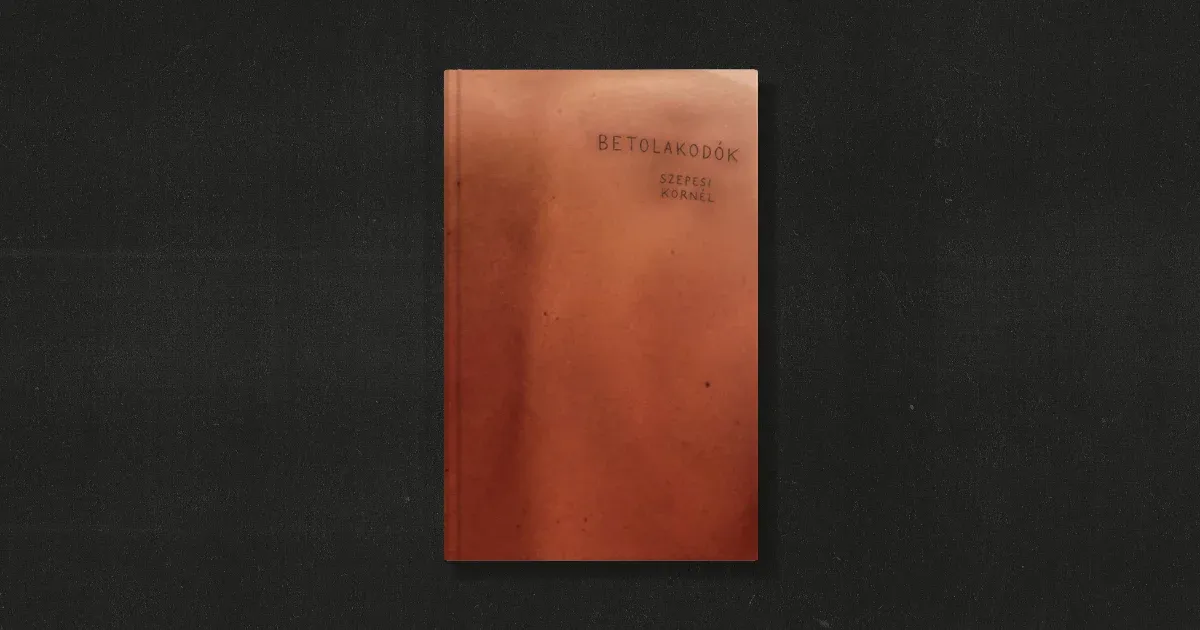
Kornél Szepesi: Intruders
FISZ, 2026, HUF 3500
Főkép forrása: telex.hu