
„I would be very careful about saying who is a kitschy painter and who is a genius”
– said sculptor Janos Megyeri to Népszava when asked about the work of Noémi Vészabó, who was awarded the Munkácsy Prize. With this one sentence, Megyeri touched upon the fact that it is very difficult to objectively judge the quality of a work of art, especially when someone has not received any art historical training, like the students in elementary schools have not been taught for years. It is easy to dismiss any argument by saying it’s about art, self-expression, and that the viewer simply does not understand what it is all about.
„…my opinion is not important, but the fact that in Florence at the Biennale and in Barcelona, the Museum of Modern Art also exhibited one of her paintings, as did the Louvre – the latter did not happen for any other contemporary Hungarian artist”
– Megyeri also says this in the article, revealing what are the objective criteria that the art world, including artists, gallery owners, curators, try to establish by determining the number and locations of exhibitions, defining the significance of an artwork or artist. Last but not least, awards, recognitions, honors. Munkácsy Prizes.
The problem with this is that while it might seem like an absolute objective recognition to an uninformed reader that Vészabó exhibited in Florence, Barcelona, and even in the Louvre, looking closer reveals a much more complicated picture. Or rather: much simpler, because
these appearances can be bought into.
Starting with the Louvre: Vészabó did not exhibit in the legendary museum where the Mona Lisa is, but in the Carrousel du Louvre, an underground shopping center next to the museum. There, in a booth. Imagine walking in a mall and being able to see an artist’s exhibition in a ground floor booth – this is what Vészabó presented as the Louvre, in the context of the Masters of Modern Art exhibition.
The exhibition held in the Carrousel du Louvre was organized by a network called PAKS, unfortunately not a Hungarian one, and its website lists the requirements in a PDF. In this case, the requirements mean a specific amount of euros, between 900 and 2850 euros (currently between 360,000 forints and 1.1 million forints) depending on the size of the artwork, to have our picture displayed there.
In exchange for the money, we will be included in the catalog, receive a complimentary copy, be featured on the website, and if the artwork is sold, the organizers keep 10%.
Just like with budget airline tickets, you can also purchase extras: for 150 euros, your name can be mentioned in a promotional video for the exhibition for 3-5 seconds, and for 1000 euros, you get two separate pages in an art album.
PAKS has exhibition spaces in Vienna and Munich, and also organizes similar art fairs in Cannes and Basel, among others. Culturally informed readers probably already recognize that Cannes and Basel host two quite significant cultural events, the Cannes Film Festival and the world’s largest art fair, Art Basel. Obviously, the fairs organized by PAKS have nothing to do with these, but the line between a superficial reader and an inattentive journalist is dangerously thin when it comes to Art Basel and the Fine Art Biennale Basel.
This kind of similarity is present at two other international exhibitions featuring Vészabó. One is the Florence Biennale, which is clearly not the Venice Biennale, one of the world’s largest international exhibitions, but if you have a faint idea of Italy, you might mistake them. The other is – as Megyeri also mentioned in his statement – the Museum of Modern Art in Barcelona. The latter, especially in Hungarian, is easy to identify as the MEAM, the Museu Europeu d’Art Modern, a long-established institution with 139 artists selected from their collection for the current exhibition. The main exhibition at MEAM is currently this.
In contrast, Vészabó did not exhibit there, but in a space called MEAM, a showroom run by the MACBA (Museu d’Art Contemporani de Barcelona), a publicly supported institution where the current exhibition is on display. The MEAM’s main exhibition is currently this.
In Florence Biennale and at MEAM in Barcelona, two Italian names appear: Francesco Saverio Russo and Salvatore Russo. Francesco’s name can also be seen at the International Prize Michelangelo, and this award is also listed on Vészabó’s social media and Wikipedia pages. After a short internet search, it can be revealed that the Russo brothers operate an entire network of awards, having also given out the Leonardo da Vinci award (won by Vészabó), a Donatello award, and recognition called Italy: The Genius of Art.
Regarding the latter, an amateur artist posted on Facebook in 2019, explaining how the Russo duo reached out offering congratulations on a huge award win, with only 190 euros left to be paid in order to receive it, or for a few hundred more euros, the artist could get included in a catalog as well. A video was also made to celebrate the Donatello award, showing the number of times 190 euros were likely collected:
Illusion
„In the psychology of all this, there is a need for something that seems objective as validation, so that you don’t just tell yourself that you are good and world-class, but can convince others as well,” says Áron Fenyvesi, an art historian and chief curator of the Hungarian and international artists at ACB Gallery.
Fenyvesi says that it is important to know that the more serious art fairs do not directly address artists, but galleries. There is a very strict selection process that, even if a gallery passes, it will have to pay thousands or tens of thousands of euros to be present at the event. Fairs such as Art Basel or Frieze London are much more prominent in the art and art collecting world than, say, the Venice Biennale was twenty years ago.
These phantom film festivals also exist, although the term „existence” might not be the best fit for them. These events lure in young, inexperienced filmmakers by promising great networking opportunities or the chance to win awards. It turns out that there is no audience, no professional program, and most screenings take place in hotel conference rooms. These events charge an accreditation fee for applications, and then, in exchange for other costs, provide questionable services. The difference here might be that in the film world, there is a portal called FilmFreeway that helps filmmakers apply to these festivals, and they try to do everything to filter out and ban scams. But it doesn’t always work, as this 2019 Hollywood Reporter article explains.
Crucifixion
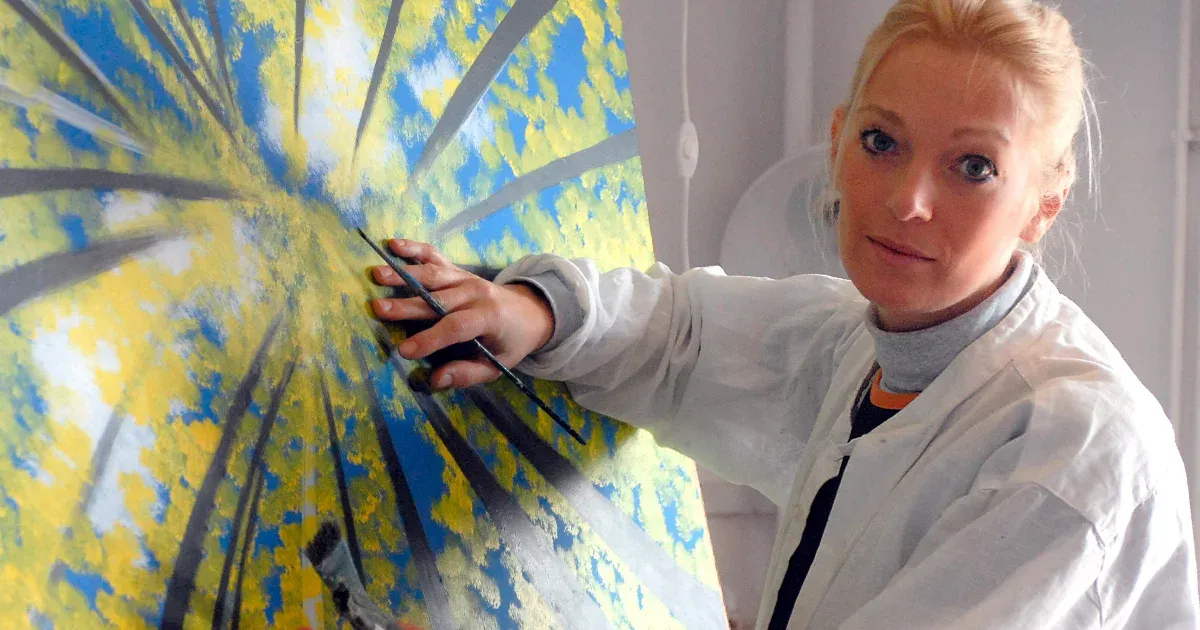
This year, Noémi Vészabó received the prestigious painter’s state award, the Munkácsy Mihály Prize, which comes with a cash prize. Vészabó was immediately criticized for the quality of her work, and a petition was launched demanding that she return the award.
The committee proposing Vészabó for the Munkácsy Prize resigned shortly after, in part because, according to them, Noémi Vészabó, whom they consider an „amateur, market-level painter,” was elevated to the ranks of recognized artists when she did not even appear on the initial, much broader list of 150 nominees. The committee members are: János Aknay, Károly Elekes, István Erős, Ádám Farkas, Zsolt Petrányi, and György Verebes.
The committee’s task is to nominate 14 artists each year for the prize awarded on March 15. The decision on who ultimately receives the award is made by the Minister of Culture and Innovation, currently Hankó Balázs. According to 444, artists Melocco Miklós, Párkányi Raab Péter, and Latorcai János lobbied for Vészabó’s award, while the committee’s resignation was not only about the Munkácsy Prize, but it also resulted in only two of the fifteen winners nominated by the members themselves.
Besides painting, Vészabó is also involved in writing, with several books published through the Galenus Pharmaceutical Journal and Publishing Company, currently available in the webshop. Galenus is under the supervision of the Hungarian Chamber of Pharmacists, led by Zoltán Hankó – the minister’s father, says 24.hu.
The artist – who has been accused of plagiarism for days – spoke to Népszava since the outbreak of the scandal:
„It doesn’t have to appeal to you what I do, but many people like and appreciate it. I don’t understand the crucifixion.”
Főkép forrása: telex.hu